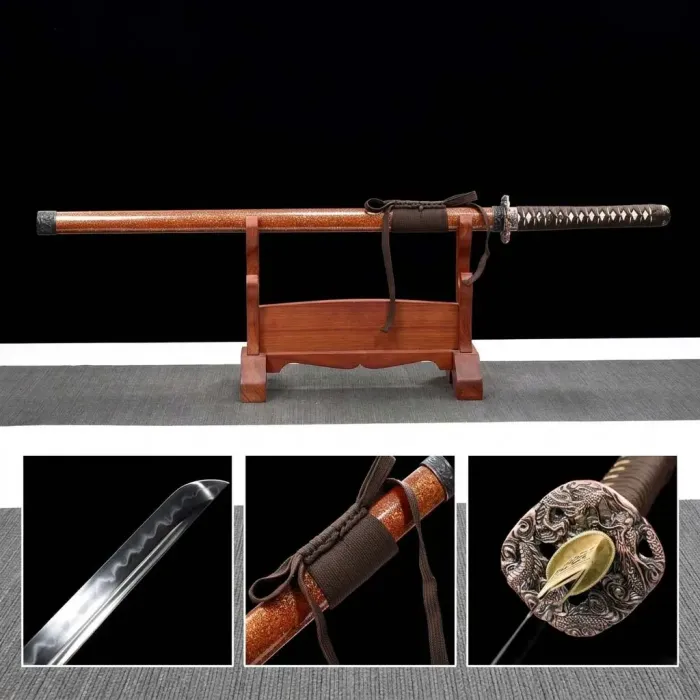
The time-honored oriental sword serves as a stunning expression of ingenuity, but consider if you want to manifest your distinct manner? Personalizing your sword is a insightful journey, allowing you to create a truly matchless piece. From the hilt wrapping and habaki to the shield design and temper line, each part offers a chance for unique expression. This analysis delves into the area of katana adjustments, providing facts for both rookies and seasoned enthusiasts pursuing to establish their stamp on the historic art of the samurai.
Novice's Original Mastery
For those wanting to embark on the fulfilling journey of historical swordplay, 1060 steel katanas present an excellent entry point. This specific grade of structural steel hits a perfect balance between price and quality . While not as hard as supreme steels, 1060 accommodates a moderate level of cutting preparation , making it tailored to newcomers to learn the groundwork of sharpening care and value the grace of expertly made Japanese weaponry. It’s a remarkable choice for gaining experience without the financial burden of more elite steels.
T-10 Steel Cutlasses: Managing Performance and Expense
To help connoisseurs seeking an authentic blade experience without overwhelming the wallet , T10 substance katanas represent a compelling option. These daggers offer a considerable improvement in endurance compared to inferior alternatives, exhibiting good edge retention and enough flexibility for initial cutting techniques. While not rivaling the premium characteristics of superior steels like T100 or folded compound, T10 provides a remarkable blend of ability and economy , making them a appreciated choice for apprentices and those on a limited budget .
Transcending the Sword : Adapting Your Armament's Accessories and Haft
Considering the smoothed metallic edge is undeniably the key point of a katana, truly refining its aesthetic lies in the meticulous customization of its fittings and grasp . This approach allows craftsmen to reveal their distinct taste . Consider the comprehensive possibilities: menuki - decorative accents that add visual focus; the hamon sleeves – often carefully engraved ; the tsuka nucleus itself, wrapped in classic ito rope ; and the fusa pommel , which can be designed from various resources like gold or tusk .
- Choose subjects that align with you.
- Evaluate with diverse composites .
- Focus on strength for a enduring influence .
The Enchantment of the Katana: Past, Crafting, and Elements
A samurai blade contains a incomparable allure, steeped in phases of Nippon's history and custom . More than merely a implement of battle , it's a icon of the knight ethos – a fusion of prowess and discipline . Its evolution spanned many generations, with early cutting instruments evolving into the polished curvature and sharp edge we distinguish today. The construction involved is truly spectacular, requiring epochs of preparation to complete. The process involves a sophisticated folding of wrought steel , creating layers that reinforce the weapon’s flexibility and carving ability. Diverse schools of metalworking developed , each with their own secrets and methods for achieving the optimal poise and sharpness - a truly challenging pursuit.
- Original Katana types
- The role of the historical weapon in fighter culture
- Ancient manufacturing approaches
Selecting the Optimal Steel for Your Bladed Weapon Project: 1060 vs. T10
Determining the right steel is crucially important for any sword project, and the option between 1060 and T10 can be intricate. 1060 is a widely used American compound, offering a competent balance of strength and sturdiness, supplying it fairly easy to process. However, T10, a Oriental steel, commonly boasts superior wear longevity and can likely achieve a superior end hardness, although it can be relatively demanding to handle and requires careful heat tempering. Consider your proficiency and intended results: for a first-timer, 1060 may be a better basis, while the seasoned smith might prefer the enhanced attributes of T10.
- Convenience of Processing
- Abrasion
- Ultimate Hardness
Opening the Possibilities: Elite Katana Enhancement Procedures
Developing mastery in sword customization extends far beyond basic honing. Serious enthusiasts are now studying advanced techniques to truly liberate a blade's hidden potential. This involves intricate work with the blade border, utilizing specialized compounds for differential annealing and carefully identifying the profile of the shield to optimize balance and handling. Beyond purely functional tweaks, artisans are increasingly focused on producing unparalleled aesthetic elegance, through complex engraving and layered films that truly transform a katana into a masterpiece.
Transforming Basic Steel into Art: Building a 1060 Sword
The journey opens with conventional 1060 iron , a hard material far absent the refined katana it will evolve . Proficient bladesmiths execute a complex process of combining and crafting the initial steel, repeatedly tempering it and flattening it to remove impurities and produce a even grain structure. This sword custom demanding process, often persisting for stretches , builds the crucial sturdiness and malleability characteristic of a legitimate Japanese cutlery . Supplementary heat adjustments , including meticulous hardening and conditioning , are essential to achieve the specific equilibrium of sharpness, durability and magnificence.- Integrating: Minimizes impurities and forms grain structure.
- Shaping: Fabricates the steel into the initial blade form.
- Hardening: Establishes the final hardness and flexibility.
The Lasting Drawing of the Katana: An In-Depth Look at Metal and Personalization
Each historic katana remains a forceful symbol of Japanese custom , its allure far overtopping mere combat tools . Forged from rare steel and often featuring intricate motifs , the system of creation itself is a respected art. Beyond the essential craftsmanship, the ability to personalize a katana - from the hamon to the grip wrapping and fastening - allows for a authentically individual demonstration for both collectors and carriers alike. This union of tradition-rooted steelwork and boundless personalization contributes the katana's continued prominence across the earth .