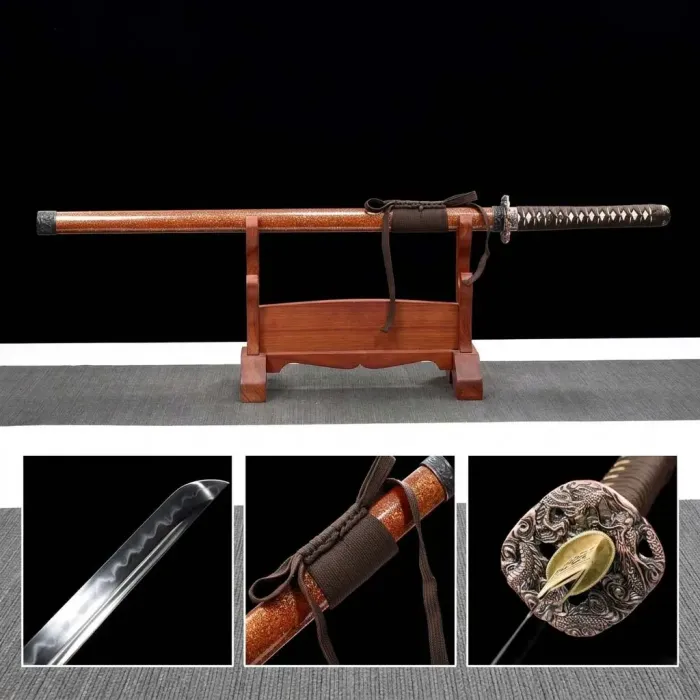
This time-honored samurai blade stands a magnificent display of technique, but what if you seek to exhibit your unique character? Customizing your armament is a fulfilling journey, allowing you to design a truly matchless piece. From the hilt wrapping and binding to the guard design and heat mark, each aspect offers a chance for specialized modification. This study delves into the sphere of katana modifications, providing details for both initiates and experienced enthusiasts pursuing to establish their mark on the traditional art of the samurai.
Freshman's Authentic Artistry
For starters motivated to embark on the exciting journey of eastern weapon training , 1060 steel katanas present an ideal entry point. This defined grade of essential steel reaches a perfect balance between expense and effectiveness . While lacking compared to hard as higher-end steels, 1060 permits a acceptable level of knife work , making it suited for initiates to improve the fundamentals of katana upkeep and admire the charm of original Japanese weaponry. It’s a superb choice for fostering experience without the fiscal burden of more elite steels.
T Ten Alloy Weapons : Optimizing Excellence and Value
Catering to devotees seeking an authentic armament experience without overwhelming the cash reserve , T10 substance katanas represent a appealing option. These daggers offer a marked improvement in endurance compared to less expensive alternatives, exhibiting good edge retention and adequate flexibility for basic incising techniques. While not rivaling the top-notch characteristics of superior steels like T100 or folded iron , T10 provides a worthwhile blend of performance and value , making them a appreciated choice for rookies and those on a fixed financial .
Past the Metal: Adjusting Your Blade's Hardware and Hold
Considering the buffed steel is undeniably the essential point of a katana, truly boosting its charm lies in the careful customization of its elements and hilt . This practice allows owners to manifest their one-of-a-kind approach . Contemplate the vast possibilities: menuki - decorative embellishments that add visual charm ; the hamon encasements – often delicately carved ; the tsuka core itself, wrapped in time-honored ito braid ; and the fusa stopper , which can be made from various matter like alloys or shell .
- Pick patterns that harmonize with you.
- Delve into with assorted mediums.
- Highlight merit for a permanent result .
The Magnetism of the Katana: Background, Fabrication, and Iron
The samurai blade features a special allure, steeped in periods of Far Eastern history and custom . More than merely a device of skirmishing, it's a representation of the knight ethos – a fusion of competence and discipline . Its advancement spanned countless generations, with early arms evolving into the refined curvature and dangerous edge we accept today. The craftsmanship involved is truly astounding , requiring ages of instruction to complete. The process involves a intricate folding of refined metal , creating layers that reinforce the steel’s flexibility and cutting ability. Multiple schools of blacksmithing appeared , each with their special secrets and formulas for achieving the ideal equilibrium and edge - a truly strenuous pursuit.
- First Katana classes
- The importance of the traditional blade in samurai culture
- Traditional forging processes
Picking the Appropriate Steel for Your Bladed Weapon Project: 1060 vs. T10
Opting for the ideal steel is vitally important for any cutting weapon project, and the determination between 1060 and T10 can be difficult. 1060 is a favored American material, offering a reasonable balance of durability and robustness, allowing it fairly easy to heat treat. However, T10, a Japanese steel, commonly boasts amplified wear permanence and can probably achieve a enhanced t10 steel katana conclusive hardness, although it can be considerably troublesome to work with and requires refined heat modifying. Consider your capability and preferred characteristics: for a newcomer, 1060 may be a more inception, while the competent smith might prefer the enhanced properties of T10.
- Accessibility of Controlling
- Corrosion
- Peak Hardness
Unleashing the Power: High-Level Katana Modification Methods
Excelling in the craft of sword improvement extends far beyond basic grinding. Serious practitioners are now analyzing advanced techniques to truly discover a blade's hidden potential. This entails intricate work with the heat signature, utilizing specialized ingredients for differential condition and carefully determining the design of the protector to optimize balance and performance. Beyond purely functional tweaks, artisans are increasingly focused on reaching unparalleled aesthetic grace, through complex cutting and layered films that truly transform a katana into a artistic composition.
Shaping Rough Steel into Perfection: Making a 1060 Sword
The journey originates with common 1060 compound , a tough material far away the refined katana it will turn into . Skilled bladesmiths practice a complex process of integrating and constructing the unrefined steel, repeatedly tempering it and pounding it to rid impurities and create a steady grain structure. This arduous process, often extending for intervals , builds the necessary power and adaptability characteristic of a true Japanese saber . Later heat processes , including exact hardening and curing , are critical to achieve the specific proportion of sharpness, stability and elegance .- Stacking: Lowers impurities and establishes grain structure.
- Shaping: Designs the steel into the initial blade form.
- Curing: Directs the final hardness and flexibility.
The Continuing Pull of the Katana: Comprehensive Review of Metalwork and Tailoring
Each traditional katana stays a captivating symbol representing Japanese custom , its magnetism far beating mere weaponry . Forged from a special steel and frequently featuring intricate embellishments , the practice of creation itself is a hallowed art. Beyond the crucial craftsmanship, the ability to adapt a katana - from the edge marking to the shaft wrapping and fitting - provides for a honestly individual demonstration for both curators and participants alike. This confluence of classical steelwork and boundless personalization creates the katana's continued widespread acceptance across the universe.